Homelab Seismic AI with Slack Alerts
Every so often, a learning journey turns into something a little more project-shaped than you originally planned. "Resonance Lab," my home brew project moniker for the AI lab I built, started that way for me: I wanted a clean, automated way to track global earthquake activity, a hobby of mine, archive the raw data, and then let a local LLM reason about what it actually means, as clean facts, without relying on cloud services.
The end result was a fully automated seismic monitoring and AI analysis pipeline running entirely inside my homelab, posting structured risk assessments straight to Slack (Micro UX since the integration is headless). This post is a walkthrough of what I built, why I built it this way, and what I learned along the way.
The Lab Environment
Everything runs on a single machine:
- Host: "lab-stt" ('stt' being abbreviation for speech-to-text which was just the starting point for the AI)
- OS: Ubuntu Linux
- Storage: RAID array mounted at /mnt/raid
- Project name: Resonance Lab
The goal was edge-first: local storage, local compute, local AI inference. Internet access is used only to pull public earthquake data from USGS.
Overview of the Pipeline
At a high level, the system does this on a schedule:
- Pull multiple earthquake CSV feeds from the USGS
- Archive raw data to RAID-backed storage
- Compute summary statistics and persist them as JSON
- (Optionally) Send the dataset to a locally running LLM for analysis
- Save the AI-generated assessment as Markdown
- Post a rich Slack notification with stats + analysis
All of that logic lives in a single .NET worker service.
The Collector Service
The heart of the project is a .NET 9 worker service called "EarthquakeCollector".
Why a Worker Service?
- No HTTP surface area
- Perfect fit for scheduled background work
- Clean integration with systemd
- First-class logging and dependency injection
The service runs continuously under systemd, waking up every 12 hours to collect data.
USGS Feeds
The collector pulls four CSV feeds from USGS:
- 2.5_month
- significant_week
- 4.5_week
- all_day
Each feed is treated independently, which keeps the logic simple and the outputs predictable.
Data Storage Layout
Storage architecture:
/mnt/raid/data/earthquakes/ ├── raw/ │ ├── 2.5_month_2026-03-28.csv │ ├── significant_week_2026-03-28.csv │ └── ... ├── stats/ │ ├── 2.5_month_2026-03-28.json │ └── ... └── analysis/ ├── 2.5_month_2026-03-28.md └── ... Raw Data
Raw CSVs are archived unchanged. This was an intentional decision, if my parsing logic fails, I still have the original data. Plus, next steps? Setting up a bit of a data anlysis pipeline to study up on that neck of the woods as a promise to a co-worker.
Computed Statistics
For each dataset, the service computes:
- Total event count
- Min / max / average magnitude
- Significant earthquakes (M4+)
- Major earthquakes (M6+)
These are saved as compact JSON files so they're easy to consume later (or feed into something like Grafana).
Local AI Analysis with Ollama + Qwen
This is where the project got fun for me instead of just studying for another certification test.
When AI analysis is enabled, the service sends the earthquake data to a locally hosted Qwen LLM, running via Ollama on the same box.
No data leaving the lab.
The model generates a seismic risk assessment in natural language, things like:
- Whether recent activity is clustered or diffuse
- Presence of high-magnitude outliers
- Short-term risk signals worth monitoring
The result is saved as a Markdown file alongside the stats.
This setup hits a sweet spot for edge AI: with reasoning, but still entirely in a self contained lab.
Slack Notifications (When You Want Them)
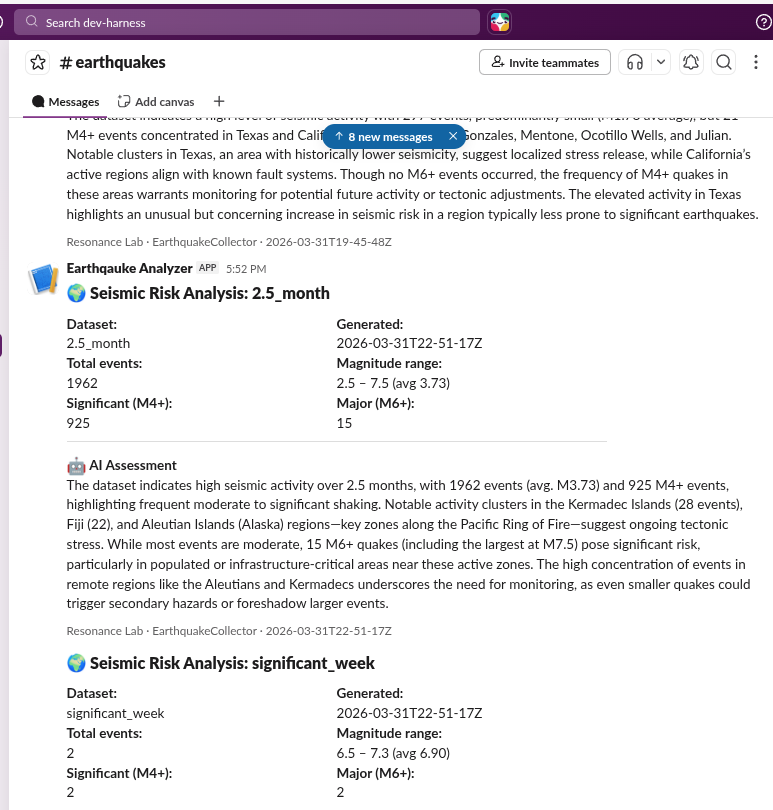
After a successful AI analysis, the service posts a notification to Slack using an incoming webhook.
Design Principles
- Opt-in only If the webhook URL is empty, Slack is disabled.
- AI-gated No AI analysis → no Slack message.
- Failure-tolerant Slack errors are logged as warnings. The service never crashes because Slack is down.
Block Kit, Not Plain Text
Messages are built using Slack Block Kit and include:
- A header with the dataset name
- Structured fields for:
- Timestamp
- Total events
- Magnitude range (min / max / avg)
- Significant and major counts
- A divider
- The full AI assessment
- A context footer identifying Resonance Lab and the service
Slack has block size limits, so the AI response is truncated to a set number of characters to stay safely under the cap.
The result is readable, scannable, and useful on mobile.
Deployment: Self-Contained .NET on Linux
One of my favorite parts of this setup is how boring deployment is, it's a home lab backed by source control after all. KISS
Self-Contained Build
The service is published with:
dotnet publish \ -c Release \ -r linux-x64 \ --self-contained true That produces a single binary. No .NET SDK. No runtime installation. Just copy it over and run. Thank you Microsoft for the Open Source nature of .Net, right here.
Deployment is handled by a simple shell script that uses rsync to push the build to lab-stt.
systemd Integration
The service runs under systemd with explicit resource controls, again, homelab and I have yet to setup a stand alone GPU, unfortunately my assumptions about cannibalizing the onboard Video card were false and I don't want to spend a lot of cash, or waste power:
- Memory limit: 512 MB
- CPU quota: 25%
That's enough for CSV parsing and the Qwen3 LLM calls, and it keeps the service from bonking if something goes wrong, and I can manage multiple experiments at once while personally using the services I am building instead of burning tokens.
Lessons Learned
This project packed more "real-world ops" lessons than I expected.
1. GitHub SSH Auth on Headless Servers
If you're cloning repos on a server without a GUI, set up SSH keys early. Debugging auth issues over a serial console is a bit more "hot wire" than one would think.
2. Self-Contained .NET Is a Game Changer
Being able to deploy a .NET service to Linux without touching package managers or runtimes is a real plus, especially in homelab environments where you want minimal sprawl. Not for production jobs, of course.
3. Slack Webhooks Are Easy… Until They Aren't
Incoming webhooks are simple, but:
- Block Kit limits are real
- Long AI responses need truncation
- You will forget to secure the webhook URL at least once
Treat the webhook like a secret, and design for failure from day one.
Why This Was Worth It
Resonance Lab was never really about earthquake analysis, fun though that is. It's about my GEN, vision, NLP and STT AI platforms mastery path, in a closed environment, as yet another tool in the automation space:
- Public data, locally archived
- Deterministic stats I can verify
- AI reasoning I control, with safeguards
- Notifications that inform the user
And maybe most importantly, it's fun to wake up, check Slack, and see the homelab summarizing fresh seismic activity from all over the planet.
If you're into homelabs, .NET on Linux, or running AI models where you control the stack, I can't recommend this kind of project enough. It simply requires you to define an objective, "what do I want to learn?" Then, setting your success criteria. Executing the build. Taking constructive lessons that only make you a better engineer in the process.
Happy building.
References
- Earthquake Data, .NET, and Local LLM Reasoning, the earlier post covering the original console-based earthquake analysis demo
- USGS Earthquake Hazards Program feeds and web services
- Slack Block Kit Builder
- .NET Self-Contained Deployment